

Gundam models have become a real favorite among both collectors and builders worldwide. Some models have actually sold for over 10,000 SEK at auction. Despite this, it's far from only the most expensive models that attract the most interest. What's most interesting is how grade differences – the models' own leveling system – actually make all the difference for both value and the building experience.

Table of Contents
- What are Gundam grade differences and their significance?
- Why are grade differences important for collectors and enthusiasts?
- How does the classification of Gundam models work?
- Key concepts and terminology in Gundam grade differences
- Connection between Gundam grade differences and collector's value
Quick overview
| Tip | Explanation |
|---|---|
| Grade differences guide model building | Helps hobbyists choose models that match their experience and interests. |
| Higher grades offer more details | Models like Perfect Grade have more complexity and detail, providing a unique building experience. |
| Collector's value depends on grade difference | Higher grade differences often have higher collector's value, making them better investments. |
| Learning through progression | Each grade represents an opportunity to improve technical skills and experience in model building. |
| Terminology is crucial for understanding | Understanding model builder terminology helps communicate and enjoy the hobby more effectively. |
What are Gundam grade differences and their significance?
Gundam grade differences are a classification system that helps model builders and collectors understand the complexity and detail level of various Gundam model kits. Much like a school grade, these grades represent a specific level of quality and difficulty for model building.
Basic understanding of grade differences
Each Gundam model kit is categorized by different grade differences that indicate its size, level of detail, and complexity. These grades help hobbyists choose the right model based on their experience level and interests. According to Gundam Model Research, there are six main grade differences that cover everything from beginner level to advanced constructions.
Main grade differences include:
- Entry Grade (EG): Perfect for absolute beginners
- High Grade (HG): Popular among both beginners and experienced builders
- Master Grade (MG): More detailed models for experienced enthusiasts
- Real Grade (RG): Combines richness of detail with compact size
- Perfect Grade (PG): Most complex and detailed models
- Super Deformed (SD): Stylized models with exaggerated proportions
To help readers quickly compare the main Gundam grade differences, their features, and typical users, the following table summarizes the six primary grades discussed in the article.
| Grade Difference | Abbreviation | Typical Users | Detail Level / Difficulty |
|---|---|---|---|
| Entry Grade | EG | Beginners | Very simple, low detail, easy to build |
| High Grade | HG | Beginners/Experienced Builders | Moderate detail, easy to medium |
| Master Grade | MG | Experienced Enthusiasts | High detail, more complex |
| Real Grade | RG | Experienced/Detail Lovers | Very high detail, compact scale |
| Perfect Grade | PG | Advanced Collectors/Builders | Extreme detail, very complex |
| Super Deformed | SD | All (playful/beginners) | Stylized, simpler build, comedic style |
Why grade differences are important
Grade differences serve as a guide for model builders. They help you understand what type of model suits your skill and expectations. A beginner starting with a Perfect Grade model might be overwhelmed by the complexity, while an experienced builder might find an Entry Grade model too simple.
Each grade represents not only difficulty but also a unique aesthetic experience. Entry Grade models focus on simplicity and accessibility, while Perfect Grade models offer an almost museum-quality level of detail and precision. Choosing the grade difference is as much about personal enjoyment as it is about technical ability.
Why are grade differences important for collectors and enthusiasts?
Grade differences play a crucial role in the Gundam model building world, and they are more than just a simple categorization. They represent a complexly designed guide that helps enthusiasts navigate through the fascinating world of model building and collecting.
Collectors' perspective
For collectors, grade differences are not just a technical classification but a measure of authenticity and complexity. According to Gundam Collector Magazine, the grade difference determines not only the model's difficulty but also its potential future collector's value. A well-preserved Perfect Grade model can become a valuable investment for passionate collectors.
Important aspects for collectors include:
- Rarity: Some grade differences are produced in limited editions
- Detail: Higher grades represent more complex constructions
- Historical value: Older and unique models can increase in value over time
Enthusiasts' perspective
For model builders, grade differences are about personal development and challenge. Each grade represents a new opportunity to improve their technical skills. A builder can start with Entry Grade models and gradually advance to more complex Master Grade and Perfect Grade constructions.
Grade differences function as a progressive learning journey where each level introduces new techniques, tools, and construction challenges. They encourage continuous learning and personal improvement within the hobby.
Furthermore, different grade differences offer different aesthetic experiences. A High Grade model might be perfect for quick assembly, while a Perfect Grade model becomes an almost artistic process requiring patience and precision.
How does the classification of Gundam models work?
The classification of Gundam models is a sophisticated system based on meticulous technical and aesthetic parameters. This system helps both manufacturers and enthusiasts understand and categorize the complexity and characteristic features of different models.
Technical parameters for classification
According to the Gundam Technical Research Institute, classification is based on several important factors that together create a comprehensive assessment of each model kit. Scale, level of detail, and assembly difficulty are the primary criteria that determine a model's specific grade difference.
Main technical classification parameters include:
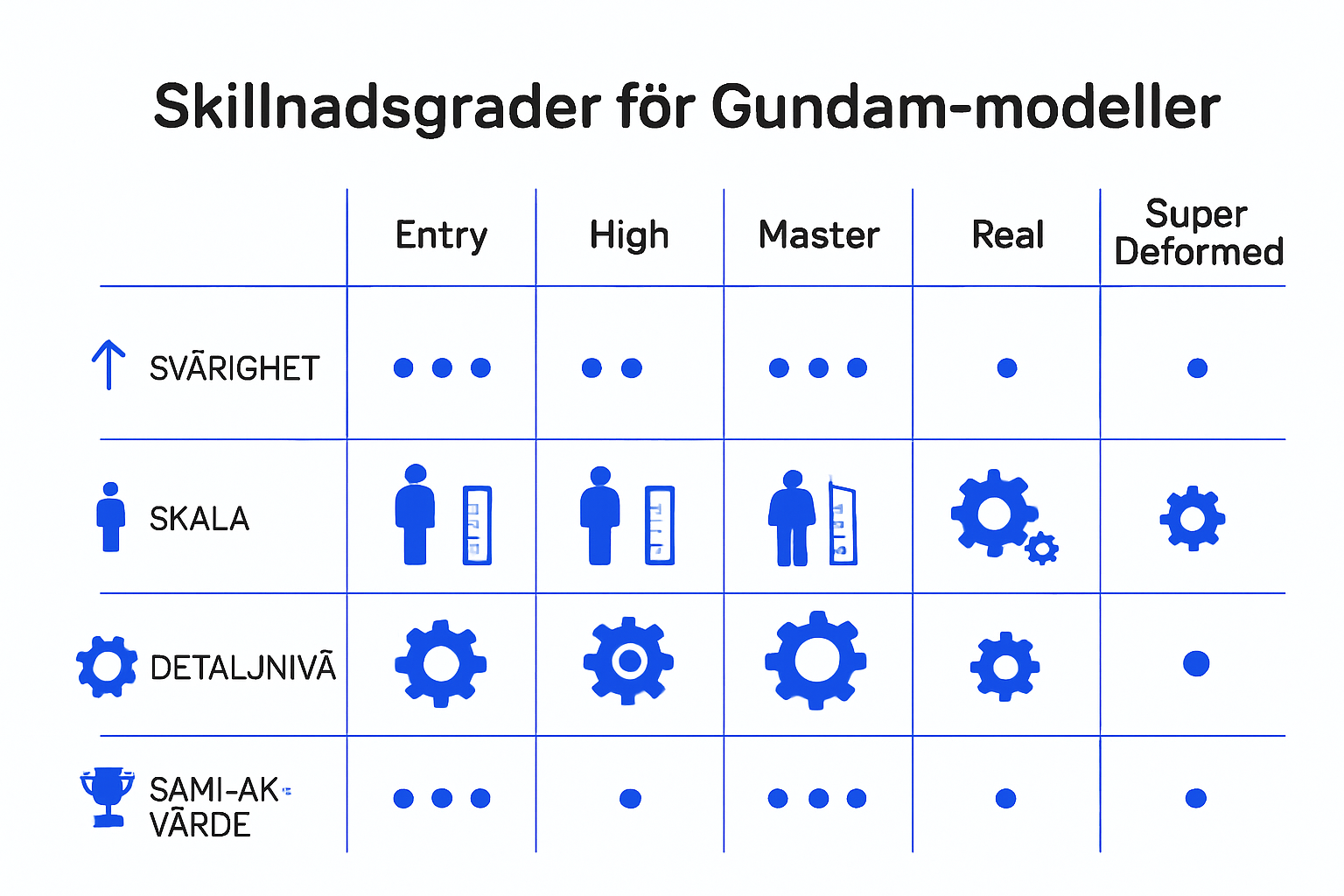
- Scale size: From compact 1:144 to impressive 1:60 sizes
- Number of components: The complexity of the number of parts required for assembly
- Articulation possibilities: How movable and flexible the models can be
The role of the design process
The design process plays a crucial role in classification. Each Gundam model kit undergoes a meticulous development phase where engineers and designers work together to ensure that the model meets specific requirements for its respective grade difference.
Design teams focus on three main aspects:
- Technical precision
- Aesthetic representation
- Assembly experience
By balancing these elements, manufacturers can create models that suit different skill levels and preferences of collectors and builders. Explore our latest model kits to see how these principles are implemented in practice.
The classification system is dynamic and continuously evolving, reflecting the technical innovation within the Gundam universe. Each new grade difference represents not only a technical achievement but also a story of passion, precision, and creativity.
Key concepts and terminology in Gundam grade differences
The Gundam modeling language is complex and filled with specialized terms that can be overwhelming for beginners. Understanding the terminology is crucial to fully appreciate and enjoy model building.
Basic modeling concepts
According to the International Gundam Modeling Association, there are several central concepts that define the vocabulary of model builders. These terms help enthusiasts communicate accurately and precisely about their models and building techniques.
Key terms include:
- Nipping: The process of removing plastic parts from sprues
- Detailing: Adding extra details to enhance the model's realism
- Kitbashing: Modifying models by combining parts from different sets
Advanced technical terms
For experienced builders, there are more sophisticated concepts representing higher levels of modeling artistry.
For readers unfamiliar with core Gundam modeling concepts and advanced techniques, this table provides clear definitions of specialized terminology used throughout the article.
| Term | Explanation |
|---|---|
| Nipping | Removing plastic parts from sprues |
| Detailing | Adding extra details for increased realism |
| Kitbashing | Modifying models with parts from different kits |
| Weathering | Technique to give the model a worn, used look |
| Panel lining | Highlighting the model's lines and structure |
| Dry brushing | Painting technique for textures and visual depth |
These terms reflect the technical skill and creativity of the most dedicated enthusiasts.
Advanced modeling terms include:
- Weathering: The technique of making models look used and worn
- Panel lining: Highlighting the model's structural details
- Dry brushing: Painting technique to create textures and depth
Explore our detailed modeling sets to practically apply these advanced techniques.
The terminology within Gundam grade differences is more than just words. It is a language that unites passion, precision, and creativity. Each term represents an aspect of the complex and fascinating world of model building, where every detail tells a unique story of design, technology, and artistic expression.
Connection between Gundam grade differences and collector's value
The collector's value of Gundam models is not just a coincidence but a result of complex factors where the grade difference plays a crucial role. Each grade difference represents more than just a technical classification but is a direct indicator of the model's potential future value.
Factors influencing collector's value
According to Gundam Collector Research, several critical components determine a model's collector appeal. The grade difference is one of the most significant factors that directly correlates with the model's market value and collector interest.
Key components for collector's value include:
- Production quantity: Limited editions increase value
- Model condition: Unopened and perfectly preserved models have the highest value
- Historical significance: Models from specific series or eras
Economic dimensions of grade differences
Perfect Grade and Master Grade models tend to have the greatest collector's value due to their complexity and richness of detail. The higher the grade difference, the more likely the model is to appreciate in value over time.
Economic aspects influencing collector's value:
- Originality and uniqueness
- Technical complexity
- Aesthetic representation
Explore our exclusive modeling collections to find potential future collector's treasures.
However, collector's value is not just economic. It's about passion, history, and the story each model represents. A well-preserved Gundam model is more than an object; it's a monument to design, technology, and artistic precision.

Discover the right Gundam grade for your collection – Start at Robotto.se
Have you ever faced the difficulty of choosing among different Gundam grade differences and felt unsure which model truly suits your level and collecting ambitions? Here at Robotto.se, you can easily find models whether you are a beginner or looking for the most advanced and detailed kits. We guide you through the differences so you can enjoy and develop in your hobby without unnecessary stress or wrong purchases.

Explore our wide range of Gundam models across all grade levels and make a confident choice today. Maximize collection value and experience the joy of the right level of detail. Visit Robotto.se where new releases, original model kits, and accessories await you. Want more inspiration? Check out our latest model kits and elevate your collection now. Become part of Sweden's leading community for enthusiastic model builders – start collecting or build your next-level masterpiece today!
Frequently Asked Questions
What are Gundam grades?
Gundam grades are a classification system that helps model builders understand the complexity and detail level of different Gundam model kits.
What are the different Gundam grades?
There are six main grades: Entry Grade (EG), High Grade (HG), Master Grade (MG), Real Grade (RG), Perfect Grade (PG), and Super Deformed (SD).
How do I choose the right Gundam model based on its grade?
The choice of model depends on your experience and interest. Beginners can start with Entry Grade models, while experienced builders can choose Master Grade or Perfect Grade models for a greater challenge.
Why are grades important for collectors?
Grades are crucial for collectors as they affect a model's collectible value and authentic significance. Higher grades can mean better details and potentially higher value over time.